
If you like chicken noodle soup then you know it’s not only tasty but also quick and easy to prepare.
Do you want to share some with your pet dog?
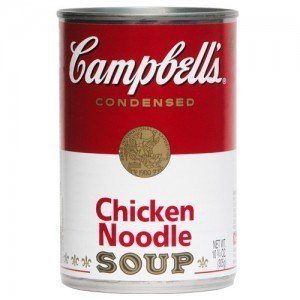 First thing’s first:
You’ve got to watch out for the salt content Most soups, Campbell’s included, are very high in sodium which is not good for any dog!
And any added garlic and/or onion will add some level of risk as well.
The point is you must carefully read labels whenever feeding canned soups.
Your Dog Can Eat Chicken Noodle Soup (but scrutinize ingredients)
Even with a quality recipe, feed this favorite only occasionally and in moderation.
Truth be told, there are typically some ingredients in store-bought chicken noodle soup that can harm your dog.
The sodium content is probably the biggest concern. Another questionable aspect for canines is Monosodium glutamate (MSG).
Of course, there are different ways to prepare chicken noodle soup. It is difficult to generalize, but one thing is certain:
Campbell’s soup is not healthy for anyone, dogs included!
Homemade is Much Better
If your dog not feeling well, perhaps due to the flu or an upset stomach, making soup at home is much preferred.
The basic ingredients are almost always the same:
- Chicken broth
- Carrots
- Noodles
Make your soup from scratch and you’ll avoid introducing unnecessary chemicals and excessive salt!
Way Too Much Sodium
Lots of salt can cause thirst and urination which can lead to poisoning.
Symptoms include:
- Diarrhea
- Tremors
- Depression
- Seizures
Less likely is a possibility that onions and garlic will contribute to anemia. The thing is, while rare, these foods can sometimes destroy red blood cells.
Symptoms associated with this condition include vomiting, weakness, and dullness.
Again, checking of labels is essential!
Moderation is a Must
Many humans foods are safe such as lean meats, many fresh fruits and vegetables, but others can do serious harm.
The key is to use moderation which goes for chicken noodle soup as well.
Although it’s alright to feed some people foods from time to time, you should closely observe how it affects your dog. A stomachache, for example, is an obvious sign that a particular food doesn’t agree with them.
Quite honesty…
Something like Campbell’s soup does not suit your dog’s needs very well.
Some Dangerous Ingredients
Salt, onions, and garlic are not the only foods dogs should not be fed.
Others considered harmful are milk and most dairy products plus raw eggs, sugary products and fat trimmings.
Since chicken noodle soup can include many of these ingredients it’s important to know exactly what’s inside. Any unnatural chemicals, of course, are also not healthy.
The Bottom Line
Homemade chicken noodle soup is, by far, much safer and healthier for your dog compared to store-bought recipes.
We do not recommend feeding your precious pet dog Campbell’s soup or any other brand that contains high sodium and other undesirable ingredients.
We put tomato soup on our dogs hard food to get them to eat and as a little treat. They are very particular. We mix with water and pour over food. We use about a half a can per 4 dogs with water mixed in. Thoughts?
I cook chicken breast and chicken leg, with no garlic or onions, and add some chopped carrots as well as celery and potatoes. My dog, a little Shih Tzu, loves it.
If you live where it snows, dogs get cold and sick. Homemade chicken soup makes sense. To keep your dog regular, without constipation, you can put sweet potatoes in the chicken soup too.
Can I use Campbell’s chicken broth, with 30% less sodium, to make chicken soup for my 13 year Bichon with stomach problems?
We give our Bichon canned chicken noodle soup mixed with plain white rice when she has stomach issues. It really helps her. I am neither a vet nor a nutritionist, just a dog lover.
Instead of Campbell’s Chicken Soup one could easily boil some leftover chicken with bones removed. Then just let it cool and feed to your puppies. It is good for their coat. I freeze mine and feed it to my Yorkies. They love it and sometimes I put some carrots in there. It’s a treat that a Yorkie breeder recommend to me.
I give my dogs my homemade chicken noodle soup. I leave out onions, also garlic and don’t use salt. They love it when the weather’s cold.
Hi. Can you send me a recipe? I can’t find any good ones!
Broiled chicken thighs, bone with skin as well. 6 chicken thighs in crock-pot, fill half way with water, add some shredded carrots and/or sweet potato roughly the size of one of the chicken thighs, as well as some rosemary.
Crock-pot high setting over night or 4-6 hours, then warm as it cools down, remove just the bones with tongs, leave the fat, skin, bone gristle (cartilage).
The bones will be super clean and come out easy. Mix it up, allow to cool. I usually serve over a little bit of his kibble.
Thank you so much!
Super Helpful! Thank you!
A vet on the internet has said it’s OK to feed Campbell’s Chicken Noodle Soup to pets even though it contains onion and garlic as she considers the amount provided to be small so as to not cause any toxicity. But I also found it contains yeast extract MSG and soy protein isolate (an ingredient that always contains MSG).
As you might be aware, MSG is harmful to dogs (a spoonful of MSG can be lethal) and humans as well if consumed over a long period of time. The vet ended by saying it should only really be for flavoring and not a major part of the diet.