
Mucinex reduces congestion, sinus pain, throat phlegm and most other cold symptoms. But is it safe enough for dogs?
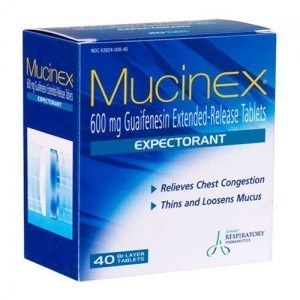 Here’s the deal:
While this cold and flu medication also works for animals, it should not be used for what could be an undiagnosed medical condition.
Further, different types of Mucinex products contain various active ingredients which means you have to be very careful.
Dogs Can Take Mucinex® But Certain Versions Are Off Limits
Providing an expectorant/cough suppressant is not a decision to take lightly.
For your dog’s sake, it is super important to read the label’s ingredients.
Harmful Mucinex Combinations
Guaifenesin has always been the main drug in Mucinex. After all, it clears mucus — hence the name! You’ll be happy to hear that it has a good safety record with respect to dogs.
On the other hand, Acetaminophen can be extremely toxic for pets.
Many of the multi-symptom Mucinex products contain Tylenol’s active ingredient and other drugs that may jeopardize your dog’s well-being.
Be sure to check the label for an antihistamine called Doxylamine succinate AKA Diphenhydramine HCL as it could complicate matters. Phenylephrine, a decongestant, is questionable as well.
The point is this:
For your dog’s safety, it is best to avoid combination forms of Mucinex. Play it safe — only Dextromethorphan and Guaifenesin are acceptable active ingredients.
Avoid a Hit or Miss Approach
Even with the right type of Mucinex, dogs with chronic respiratory illnesses cannot be effectively treated with it.
For example:
The problem could be kennel cough and, while your dog may appear to respond well, over-the-counter Mucinex would be unnecessary and also unhelpful.
Safer pet respiratory treatment options exist, but ultimately your dog could require a prescription drug such as an antibiotic.
In other words, a vet really should be involved!
What is a Safe Dose For a Dog?
Several factors can go into determining how much Mucinex to provide. The following is a general rule of thumb only:
20mg per pound of body weight taken every 12 hours or so.
Some dogs have unique medical situations that require careful consideration in terms of dosage.
Further, be careful with anything marketed as Maximum Strength as the standard dose is 1,200mg which is too much!
Regular Mucinex Expectorant as well as the DM line with Dextromethorphan HBr have lower levels of Guaifenesin and are generally easier to dose for dogs.
How You Can Deliver Mucinex
As with Robitussin, OTC Mucinex can be given to your dog orally in either liquid (syrup) or tablet form.
Both routes of administration and brands are effective when their use is appropriate.
People tend to favor liquids for the convenient use of a dropper, but breaking up tablets and putting them into dog food is another easy method.
Last but not least, depressing Mucinex tablets directly down your dog’s throat is an option.
A Wonderful Natural Remedy
One teaspoon of pure honey, taken 3 times daily, may provide relief much like Mucinex.
This natural alternative boosts the immune system, safely reduces congestion and speeds up a recovery.
Warning: Honey is not to be given to puppies.
For a Chronic Canine Cough
While Mucinex can ease all sorts of cold and flu symptoms, it may be necessary to have a vet examine your dog.
A bad cough and/or excess phlegm could be signs of other pulmonary problems or even a heart condition.
Coughing with heavy breathing may indicate pneumonia which would require immediate care.
The Bottom Line
On a short term basis, some dogs can benefit from Mucinex.
But scrutinize the active ingredients because this combo medication comes in versions that can be dangerous. And Mucinex should only be used temporarily such as to loosen congestion.
Get professional care if your dog’s symptoms persist.
Your dog could have a chronic respiratory issue in which case you can’t go it alone. Also, a prescription antibiotic may be necessary.
Be sure to conservatively dose Mucinex if your vet’s help is not possible.
My dog has Adenocarcinoma. How much Mucinex can I give her? She is 64 pounds.
My dog is a 12 year old Australian Terrier. He has a choking cough, not to severe. Is it okay to give him Mucinex? I cannot afford to take him to a vet.
My 10 pound dog consumed a Maximum Strength Mucinex DM tablet. Should I seek care for him?
My Shih Tzu is 14 years, 5 months and 2 weeks old….every day counts! Anyway, in September I took her to the vet for coughing, difficulty breathing and small fever. They gave her a checkup and decided she had bronchitis.
X-rays looked okay, so they ruled out heart problems for now. She was given antibiotics and a pink cough syrup with codeine. She did better at first, but once she was through with the medicines she began to cough again.
Two weeks ago I took her back in and they gave me a different cough syrup (green) also with codeine. I was to give it to her for 7 days and the last 3 doses as needed. I gave her a dose late last night and at 5:45 this morning she was coughing and hacking again.
I am trying to find out what I can give her. I have Tussin CF and Reli-On sugar-free cough syrup with diphenhydramine and hydrochloride. The Tussin has Guaifenesin 100mg and dextromethorphan HBr USP 10mg that I think she needs.
I have no idea how much to give her. She weighs 13 pounds. Please help. I can’t afford to take her back in and get more meds.
She may have a collapsing trachea. I have a 15 pound Yorkie that was diagnosed after taking him to a 3rd vet. He has been on every medication they could think of. They either didn’t work or gave him diarrhea.
HomeoPet Cough works most of the time. Pet Wellbeing Throat Gold works sometimes. It’s just day to day. I also use Robitussin DM.
One vet told me he had about 2 years and we are at 2 and a half years now. There is a surgery, but it is expensive and doesn’t always work. I know how hard it is.
My vet just told me to use 1 Mucinex (600mg) a day for my almost 50 pound Basset Hound. I believe he looked this information up on VIN. I noticed that Mucinex can be given twice a day. According the dosage recommended in this article this would be on the low end for my dog’s weight.
Did the Mucinex help your dog? Our pup is closer to 70 pounds. I am trying out one 600mg dose for now.
So I went to get Mucinex for my dog and as I am headed to check out, I see that it contains Acetaminophen which is Tylenol! Just three Tylenol can kill a full size dog via liver failure. I checked to see the amount and it said 325mg. Do not give this to your dogs!
You bought the wrong stuff. Look for the generic form of guaifenesin. Mucinex is a brand name. The bottle you have might say Mucinex Cold and Allergy. Stay away from those mixtures.
You were very smart to check the ingredients first. Also, be aware that liquid formulations for people often contain deadly (for dogs) sweeteners and such.
You’d have to have a complete list of ingredients and a veterinary degree! Steer clear of these unless you are specifically told they are safe by your vet.
There are lots of generic versions of guaifenesin. You must find the type that has that same time-released encapsulation on each partile, not an outer layer that causes time release and is ruined if the bill is snapped in half.
You have to use Children’s Mucinex that doesn’t contain acetaminophen.
Supply plenty of fresh water because Mucinex, or it’s generic version, has a drying effect. The extra fluids will help to move the mucus out.
My 13 year old Miniature Pinscher weighs 15 pounds and has a heart congestion. She takes two meds but her cough has lasted 2 days and it’s so bad. My vet can’t see her for 3 weeks. I read about mucus and cough relief. Can I give something like that to my dog and how much?
If your dog’s cough is that bad, and your vet will not see her for three weeks, I would suggest finding a new veterinarian. Is there another clinic that you can take her to in the meantime? Your current one can send over their records to the new vet so that they can make a proper diagnosis and prescribe something for the cough.
I have a 60 pound female Boxer. I just heard her coughing last night and again today. After reading this article, I feel confident in giving her Mucinex. I’m just worried about the amount. Can you recommend a dosage until Monday when my vet comes back and can take a look at her. Or what about (Delsym) Dextromethorphan?
After spending thousands of dollars treating my dogs for pneumonia and chronic bronchitis, I bought Mucinex. Within 2 days she was bringing up all the phlegm that had been in her lungs. I give her 1/4 of a Mucinex twice a day for a 40 pound dog.
Is that in liquid or pill form?
What dose of Mucinex would you recommend that I give my Chihuahua?
The vet just told me, for my 5 pound Chihuahua, 100-200mg but with no Ephedrine.
I read your comment about your dog and use of Mucinex. How is she doing? I have a dog with the same thing. I’ve spent so much money without good results. Thank you.
My 10 pound Terrier-mix has been diagnosed with chronic cough due to allergies. He does not cough up anything, but his breathing sounds like there is congestion in his airway. He has been on Temeril-P for years, but it has Prednisone which can have bad effects on the liver. Does it make sense to try generic Mucinex for this type of problem? Thank you.
Our Border Collie has a respiratory sickness. 2 nights ago she coughed, hacked and sneezed two hours non-stop. She was in obvious pain. It was the weekend so a vet was out of the question. We had tried Robitussin liquid but it was very difficult to administer. She did not respond.
Yesterday I bought Mucinex tablets. It has 2 times the guaifenesin (expectorant) as Robitussin. We put it in a hamburger ball and she gulped it down. Last night she slept like a baby. This morning she is alert without one cough. This may not last but if the past 24 hours are any indication, it is nothing less than a miracle.
This is a follow up. I made a mistake on my last post. The pill we gave our Border Collie was not Mucinex. It was a generic version. My pharmacist at Walmart told me to try Mucus Relief Cough which is on the lower shelf and is only $2.48 for a 30 count, tremendously cheaper than Mucinex.
The pharmacist said Guaifenesin 400mg is what gets rid of the mucus. That is a tad lower than Mucinex but it worked like a charm. Our little girl is now on the mend after suffering for months. 5 vet visits, hundreds of dollars out the window when $2.48 did the trick.
How much does your Border Collie weigh and how often did you dose her? I have a 13 year old, 65 pound rough Collie with a productive cough from his throat with a lot of thick phlegm. Even though he’s not running a fever and his appetite is fine, I’ve started him on antibiotics empirically due to his age. It’s helping a lot, but I’d like to be able to thin the phlegm up so he could cough it up easier. I have the generic Mucus Relief 400mg. Thanks!
That is so good to hear! Thanks for the info. I just gave my 20 pound Miniature Pinscher mix Mucinex today. The second dose in and her cough is much better – almost gone. Her nose is getting a little stuffy now which I’m sure is the result of the medication doing it’s job. Hopefully we will both sleep better tonight!
Do you have to give a lot of water with Mucinex?
My understanding is expectorants have a drying effect. Lots of water will loosen phlegm and help with drying. I read dosage is 20mg per pound, nothing over 1,200mg.
Thanks for the info, but could you add a general recommended dose per pound of the dog?